Wyckoff engine
Events, phases A to E, the Creek and Ice, failed structure, significant-bar inversion and shortening of thrust. Twenty-nine outputs, mirrored as MT5 buffers, and 65 condition blocks around them.
Wyckoff’s premise is that large operators leave footprints: ranges they build inside, volume they absorb, levels the market keeps respecting. This set turns that idea into blocks the StrategyQuant X builder can search, and MetaTrader 5 indicators that follow the same specification. Wyckoff accumulation and distribution is the deepest module; cumulative delta, market structure, patterns, TWAP, levels and sessions sit beside it.
Events, phases A to E, the Creek and Ice, failed structure, significant-bar inversion and shortening of thrust. Twenty-nine outputs, mirrored as MT5 buffers, and 65 condition blocks around them.
Absorption and initiative, buy and sell pressure regimes, divergences and control retests, as condition blocks.
Breaks of structure and changes of character, liquidity sweeps, fair-value gaps and order-block retests. Pivots need completed bars on both sides.
Fourteen multi-candle formations as strict, testable blocks: stars, haramis, soldiers and crows, tweezers, inside and three-method patterns.
Inside bar, the strict pin bar, bars against, 1-2-3-4 consolidation, reversal and chart patterns, and the second-wind setup.
Support and resistance, round numbers and the opening range, as prices a block can compare against.
TWAP with cross, rising and falling variants; a moving average with slope, context and bar-close tests.
Extended oscillator conditions (CCI, RSI, MFI, stochastic, MACD histogram), divergence, money flow and moving-average slope.
Eight Wyckoff strategy templates, seventeen book-pattern templates and example strategies to build from.
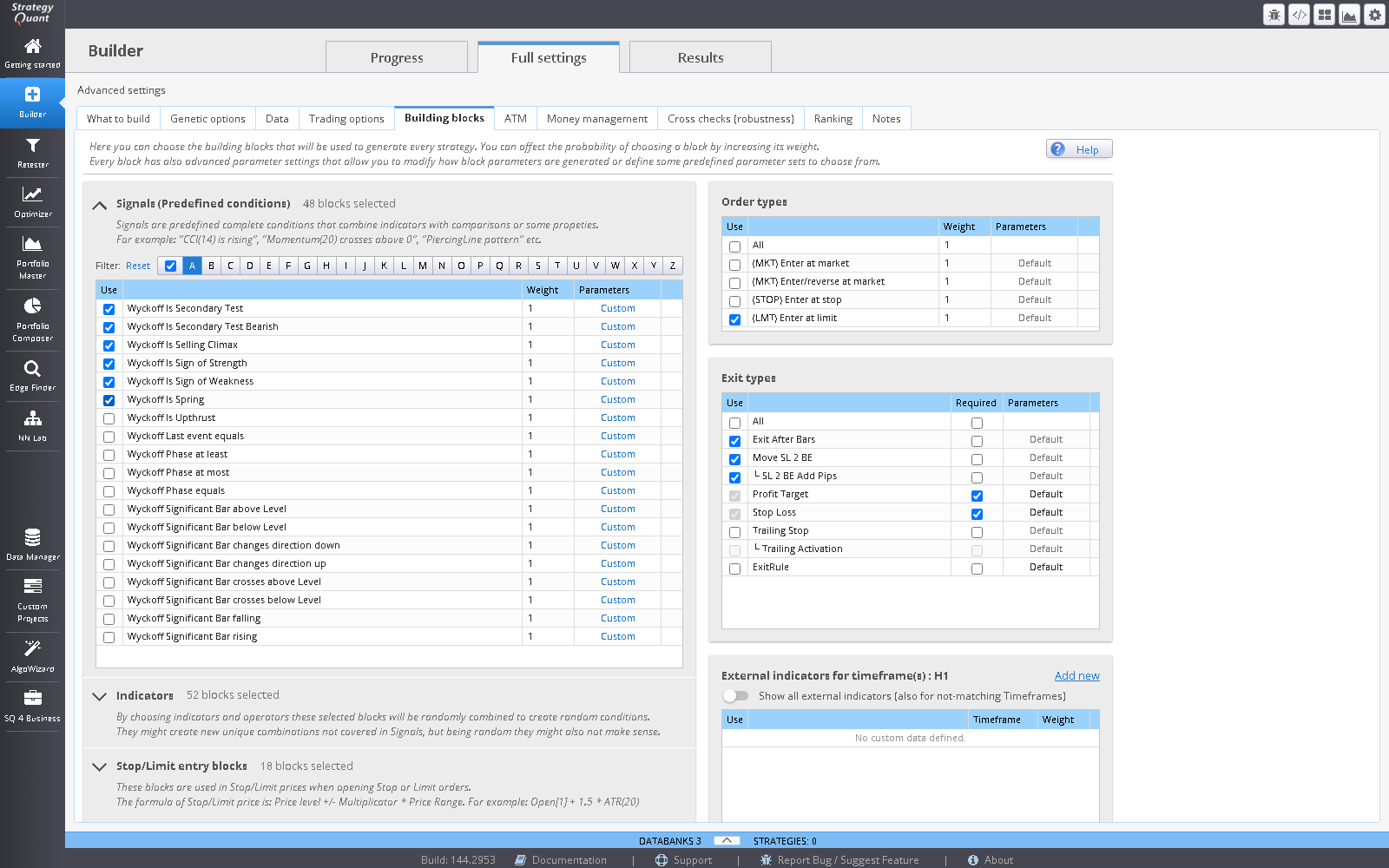
Each family comes as Java blocks for StrategyQuant X plus matching MetaTrader 5 indicators and export templates. MetaTrader 5 is the only supported export platform.
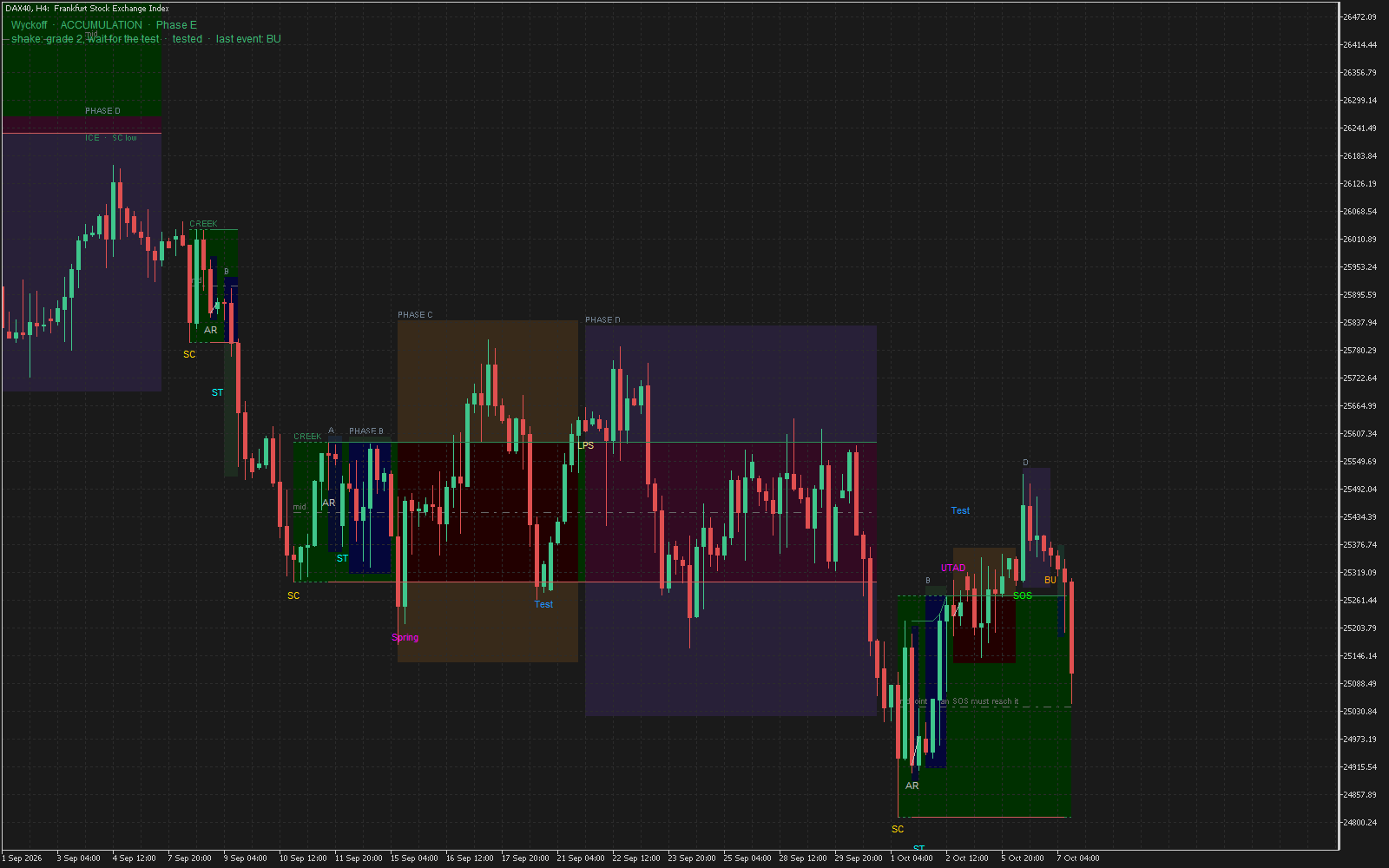
The event stream starts from a climax, anchors a trading range to it, and then tests every later bar against levels that were frozen before that bar printed. It emits signed event codes, an explicit A to E structural phase, the range zone, and the continuation context a range formed in.
| Indicator | What it answers |
|---|---|
AWWyckoffEventStream | Which Wyckoff event just printed, which phase is the structure in, where are the Creek and Ice, is this range a reaccumulation or redistribution, is the character of the range accumulative or distributive. |
AWWyckoffFailedStructure | Failed breakout and structural failure: a range that resolved and then did not hold. |
AWWyckoffSignificantBarInversion | A significant bar that flips a prior resistance or support level. |
AWShorteningOfThrust | Progress beyond the previous same-direction extreme on a run of new extremes, as a measure of fading thrust. |
AWCumulativeDelta family | Absorption and initiative detection, buy/sell-pressure regimes, divergences and control retests, as condition blocks. |
The table lists the Wyckoff engine and the cumulative-delta family. The rest of the set (market structure, candle and chart patterns, TWAP, moving averages, levels, sessions, divergence and money flow) follows the same rule: Java blocks for SQX and a compiled MetaTrader 5 indicator that computes the same numbers.
EventCode, EventPhase (signed codes, 0 means no event), StructuralPhase (A to E, signed), EventPrice.
ZoneTop and ZoneBottom give the range being tracked.
CHoCHTrendToRange, CHoCHRangeToTrend, the four sloped-structure buffers, and Reaccumulation / Redistribution: the continuation context the range formed in, frozen when the range opens.
Condition blocks cover close above or below Creek and range floor, crossings of each, entering accumulation or distribution, event-in-last-N-bars, and per-event tests such as buying climax, automatic rally and last point of support. Higher/lower/rising/falling/crosses variants exist for each indicator output.
Only closed bars advance the state machine. The bar that just opened is never stepped and then re-written.
Most of the source’s rules are stated as comparisons, so they are coded as comparisons and not exposed as inputs. EventStream runs on five functional inputs plus two optional filters that are off by default.
Each SQX block and its MT5 indicator implement one specification, and we check that they agree. For the four core Wyckoff indicators, every output of every closed bar was compared over ten parameter sets on S&P 500 H1. The other families pass SQX’s Indicator Tester, and a stricter bar-by-bar check on sparse outputs matched once the warm-up of the first bars of a series was allowed for. This checks agreement between two implementations. It says nothing about trading results.
Wyckoff analysis is partly discretionary, and any encoding of it is an interpretation. The rules follow published Wyckoff texts; those texts are not included and this product is not affiliated with their authors. Whether a given structure carries edge on your instrument is exactly what the builder and robustness checks are for. We make no claim that it does.
Edge Finder's Block Edge shows whether structure blocks earn a place on your market before the builder samples them. The signals then go to StrategyQuant to build, and to MetaTrader 5 to trade.
Trading leveraged instruments carries a high risk of loss. Software output is not investment advice and says nothing about future results. Validate every strategy yourself before risking capital.